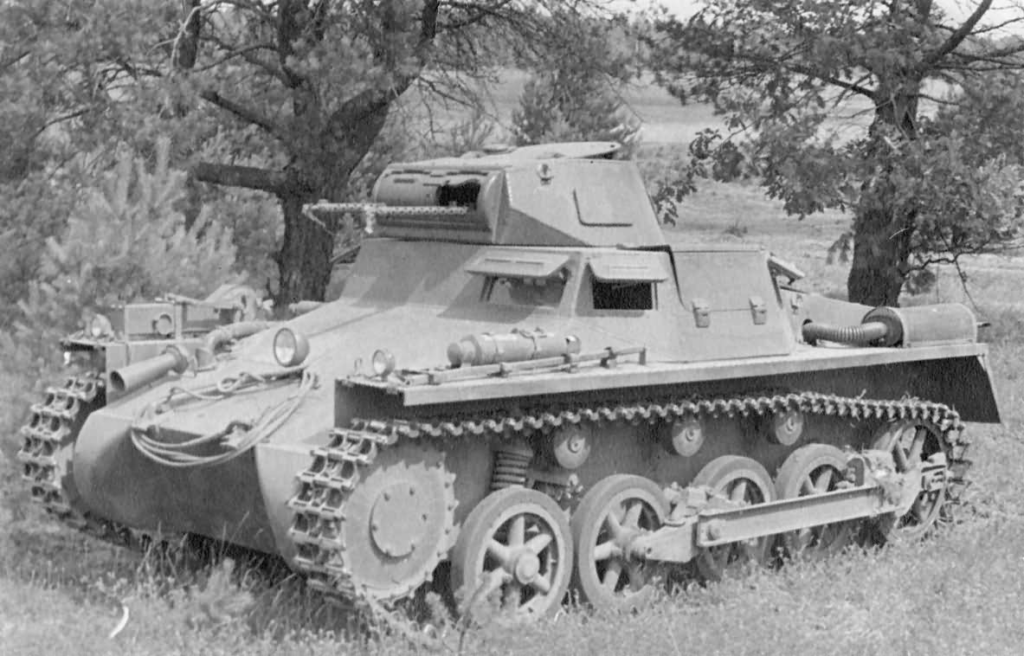
The Panzerkampfwagen I, or Panzer I, was Germany’s first mass-produced tank of the interwar period. Originally designed as a training and transitional tank, it became an improvised frontline combat vehicle in the early years of World War II. Despite being lightly armed and armored, the Panzer I family laid the foundation for later German armored doctrine and saw action in Spain, Poland, France, North Africa, and even the Eastern Front in limited roles.
In this article
This article covers the primary combat variants of the Panzerkampfwagen I (Ausf. A–F). For specialized conversions and derivative vehicles built upon the Panzer I chassis, see these dedicated entries:
- Kleiner Panzerbefehlswagen
- Panzerjäger I
- Flakpanzer I
- Sturmpanzer I “Bison”
Panzerkampfwagen I Ausf. A
Sd.Kfz. 101
Recognition: Short chassis, air-cooled engine deck, no rear vision port, early visor design. The Ausf. A had a low-profile engine deck, compact turret with four horizontal vision slits, and no rear access port. The original M 305 engine’s cooling louvers and side exhausts were visually distinctive (Spielberger, 1999, 36–38).
Origins and Development
The Panzerkampfwagen I Ausf. A was the first standardized production model of the German light tank series. It evolved from the earlier Kleintraktor and 1.Serie/La.S. (Landwirtschaftlicher Schlepper) chassis, which were originally coded to disguise tank development in violation of the Versailles Treaty. Production contracts were awarded in 1934 to several firms, including Krupp, Grusonwerk, M.A.N., Rheinmetall, Henschel, and Daimler-Benz (Jentz and Doyle, Panzer Tracts 1-1, 2002, 19).
The Ausf. A designation applied to vehicles from the 2.Serie to 4.Serie/La.S., specifically chassis numbered Fgst.Nr. 9001 to 10476 (Jentz and Doyle, 2002, 13).
Production and Numbers
A total of 1,190 chassis were assigned to the Ausf. A category:
- 2.Serie: 863 vehicles
- 3.Serie: 152 vehicles
- 4.Serie: 175 vehicles
These included vehicles later used for conversions and exports. By official inventory:
- 318 were completed by August 1935
- 720 by December 1935
- 1,065 by June 1936
- 1,160 by October 1936
(+15 exported to China) (Jentz and Doyle, 2002, 11)
According to factory records, Krupp-Gruson built approximately 750 chassis (Ausf. A and B combined), while Henschel assembled 349, and M.A.N. completed 128, mainly between 1934 and 1937 (Spielberger, 1999, 43).
Design Features
The Ausf. A used a compact two-man layout, with the commander doubling as gunner in a small rotating turret. It was armed with 2× MG13k machine guns and powered by a Krupp M 305 air-cooled 4-cylinder gasoline engine producing 60 horsepower. Transmission was a ZF F.G.35 5-speed unit (Jentz and Doyle, 2002, 4).
Armor was modest: up to 13 mm of rolled homogeneous steel, sufficient against small arms but vulnerable to anti-tank rifles and even heavy machine guns. The suspension consisted of leaf-spring bogies with four small roadwheels per side. Track type was Kgs 57/280/70, measuring 260 mm wide, with 115 links per side (Jentz and Doyle, 2002, 14).
Performance
- Top speed: 37.5 km/h
- Range (road): 140 km
- Trench crossing: 1.4 m
- Fording depth: 60 cm
- Ground clearance: 29.5 cm
- Combat weight: ~5.4 metric tons
(Jentz and Doyle, 2002, 4)
A small number of Ausf. A hulls were experimentally fitted with the Krupp M 601 diesel engine, a 45 hp air-cooled unit. These prototypes were easily recognizable by bulging external exhausts and a shortened rear hull, but performance was unsatisfactory and the project was abandoned (Spielberger, 1999, 42).
Combat Use
Although sometimes described postwar as a “training tank,” Jentz clarifies that the Ausf. A was designed from the outset for combat. In 1937, German military planners estimated that Panzer I battalions could break through infantry divisions equipped with 72 anti-tank guns. The vehicles were built with nickel-enriched steel and carried dual machine guns—not required for training tasks (Jentz and Doyle, 2002, 16).
The Ausf. A was first used operationally in the Spanish Civil War, then deployed in the invasion of Poland (1939) and France (1940). By mid-1941, surviving tanks were largely relegated to training, police, or support roles, or repurposed as conversion platforms for command, flame, or recovery variants.
Post-Production Modifications
- In 1937, a smoke grenade rack (N.K.A.V.) was added to the rear hull of some Ausf. A tanks (Jentz and Doyle, 2002, 13).
- In 1939, the Notek convoy light and tail light became standard for night operations (Jentz and Doyle, 2002, 13).
- In combat zones (esp. Poland and France), some vehicles received field-applied appliqué armor — 15 mm bolted plates over the front hull and turret face (Spielberger, 1999, 40).
Technical Summary Table
| Feature | Specification |
|---|---|
| Crew | 2 (Driver, Commander/Gunner) |
| Main Armament | 2× 7.92 mm MG13k |
| Armor (max) | 13 mm RHA |
| Engine | Krupp M 305, 4-cyl air-cooled gasoline, 60 HP |
| Transmission | ZF F.G.35, 5-speed |
| Top Speed | 37.5 km/h |
| Range (road/cross) | 140 km / 93 km |
| Weight (combat) | ~5.4 tons |
| Suspension | Leaf spring, 4 roadwheels per side |
| Fuel Capacity | 140 liters |
| Chassis Numbers | Fgst.Nr. 9001–10476 |
Sources
- Jentz, Thomas L., and Hilary Louis Doyle. Panzer Tracts No. 1-1: Panzerkampfwagen I – Kleintraktor to Ausf. B. Boyds, MD: Panzer Tracts, 2002.
- Spielberger, Walter J. Die Panzerkampfwagen I und II und ihre Abarten. Stuttgart: Motorbuch Verlag, 1999.
Panzerkampfwagen I Ausf. B
Sd.Kfz. 101
The Ausf. B followed directly from the Ausf. A to resolve its underpowered engine. A longer chassis and new Maybach engine were introduced in 1935. Total production reached 675 vehicles.
Recognition: Longer hull, five roadwheels per side, water-cooled Maybach engine with top-mounted radiator, rear air intake louvers
Origins and Development
The Ausf. B was developed to address the chronic underpowering of the Ausf. A’s Krupp M 305 engine. Krupp initially evaluated other engine options, including designs from N.A.G. and Adler, but in the end, a 6-cylinder Maybach NL 38 Tr water-cooled engine was adopted, providing 100 hp (Jentz and Doyle, 2002, p. 79):contentReference[oaicite:0]{index=0}.
To accommodate this new engine, a major redesign of the chassis was required. This included an extended hull, a new idler mounting system, and a complete reworking of the rear engine deck and ventilation system (Jentz and Doyle, 2002, pp. 80–81):contentReference[oaicite:1]{index=1}.
Production and Contracts
Officially part of the 5a. and 6a.Serie/La.S., the Ausf. B chassis were numbered from Fgst.Nr. 10478 to 14720. Production contracts were distributed among Daimler-Benz, Henschel, M.A.N., and Krupp-Grusonwerk, with a total of 399 vehicles completed (Jentz and Doyle, 2002, pp. 87–88):contentReference[oaicite:2]{index=2}.
Design Features
- Engine: Maybach NL 38 Tr, 6-cylinder, 3.8-liter water-cooled gasoline, 100 hp at 3,000 rpm
- Transmission: ZF F.G.31 5-speed gearbox
- Suspension: Lengthened chassis with five roadwheels per side; fixed idler wheel raised off the ground and track tensioned via crank arm
- Tracks: Kgs 67/280/90; 100 links per side
- Cooling: Rear-mounted fan and radiator, twin air intake ducts
- Armor: Up to 13 mm RHA, identical to Ausf. A in layout (Jentz and Doyle, 2002, pp. 79–81, 99):contentReference[oaicite:3]{index=3}
Performance
- Top speed: 40 km/h
- Range (road): 170 km
- Cross-country speed: 12–15 km/h
- Combat weight: 5.8 tons
- Fuel capacity: 146 liters
- Trench crossing: 1.4 m
- Fording depth: 60 cm
(Jentz and Doyle, 2002, p. 99):contentReference[oaicite:4]{index=4}
Armament and Crew
- Main armament: 2× 7.92 mm MG13k
- Ammunition stowage: 2,250 rounds in 61× 25-round magazines
- Gun sight: T.Z.F.2 (2.5×, 28° field)
- Elevation: -10° to +20°
- Traverse: 360° manual
- Crew: 2 (commander/gunner + driver)
(Jentz and Doyle, 2002, pp. 98–99):contentReference[oaicite:5]{index=5}
Combat Use
The Ausf. B was delivered starting around mid-1936. It fought in the Spanish Civil War, Poland (1939), France (1940), and Operation Barbarossa (1941). Although obsolete by 1941, it continued in second-line roles, training units, and conversions (Jentz and Doyle, 2002, p. 88):contentReference[oaicite:6]{index=6}.
Identification Notes
The Ausf. B can be distinguished from the Ausf. A by:
- Fifth roadwheel and longer chassis
- Wider engine deck with top-mounted air intake grills
- Relocated tools (jack and wire cutters moved to rear right fender)
- Absence of rear vision slit
(Jentz and Doyle, 2002, pp. 81, 84):contentReference[oaicite:7]{index=7}
Technical Specifications
| Feature | Specification |
|---|---|
| Crew | 2 (Driver, Commander/Gunner) |
| Main Armament | 2× 7.92 mm MG13k |
| Armor (max) | 13 mm RHA |
| Engine | Maybach NL 38 Tr, 6-cyl water-cooled, 100 HP |
| Transmission | ZF F.G.31, 5-speed |
| Top Speed | 40 km/h |
| Range (road/cross) | 170 km / 115 km |
| Weight (combat) | 5.8 tons |
| Suspension | Leaf spring, 5 roadwheels per side |
| Fuel Capacity | 146 liters |
| Chassis Numbers | Fgst.Nr. 10478–14720 |
Source
Jentz, Thomas L., and Hilary Louis Doyle. Panzer Tracts No. 1-1: Panzerkampfwagen I – Kleintraktor to Ausf. B. Boyds, MD: Panzer Tracts, 2002.
Panzerkampfwagen I Ausf. C
Sd.Kfz. 101 / VK 6.01
Ausf. C was a completely redesigned light reconnaissance tank developed late in the war. It bore no mechanical resemblance to earlier Pz I models aside from name and role.
Recognition: Torsion-bar suspension with five small roadwheels per side, overlapping track guards, and turret with periscopic commander’s cupola
Origins and Development
The Ausf. C (VK 6.01) was not a development of the original Panzer I Ausf. A/B chassis, but rather a completely new design under the Vollketten (VK) program, driven by Baurat Kniepkamp and Wa.Prüf.6. These experimental vehicles emphasized speed and compact firepower, designed for roles such as airborne operations (Luftlandetruppe) and colonial policing (Kolonialpanzertruppe) (Jentz and Doyle, Panzer Tracts 1-2, 2002, p. 154):contentReference[oaicite:0]{index=0}.
Krauss-Maffei was contracted in October 1938 to build six trial chassis (Versuchsfahrgestell), followed by a 0-Serie of 40 vehicles authorized by In.6 on 15 September 1939. Daimler-Benz designed the turrets and superstructures, while Mauser developed the specialized E.W.141 automatic rifle, intended as the primary weapon (Jentz and Doyle, 2002, p. 148):contentReference[oaicite:1]{index=1}.
Design Features
Unlike previous Panzer I models, the VK 6.01 used:
- A torsion-bar suspension system
- Five small, interleaved rubber-rimmed roadwheels per side
- No return rollers
- Maybach HL 45 P engine (150 hp)
- Semi-automatic 8-speed VG 15319 transmission
- Triple-radius steering unit LGR 15319 (Jentz and Doyle, 2002, p. 153):contentReference[oaicite:2]{index=2}
The vehicle had a two-man crew, and the turret was manually traversed through 360°, equipped with a T.Z.F.10 sight and eight periscopes for all-around observation (Jentz and Doyle, 2002, p. 148):contentReference[oaicite:3]{index=3}.
The primary weapon system consisted of:
- 1× 7.92 mm E.W.141 (semi-automatic rifle firing tungsten-core SmK H rounds at 1170 m/s)
- 1× 7.92 mm MG 34 with armored sleeve
Combined ammunition stowage: 94 SmK-H rounds and 2,100 rounds of machine gun ammo (Jentz and Doyle, 2002, p. 157):contentReference[oaicite:4]{index=4}
Protection and Armor
- Front armor: 30 mm face-hardened plate (2 cm AP proof)
- Side armor: 14.5 mm homogeneous RHA
- Rear plate: 20 mm
- Roof: 10 mm
- Hull floor: 5 mm
(Jentz and Doyle, 2002, p. 148):contentReference[oaicite:5]{index=5}
Additional 5.5 mm side applique plates were added after July 1941, bringing the combat weight to 8 metric tons (Jentz and Doyle, 2002, p. 154):contentReference[oaicite:6]{index=6}.
Performance Evaluation
The Ausf. C had exceptional on-road speed of up to 79 km/h (limited to 65 km/h operationally) and strong off-road mobility. However, by 1942–43 it was already obsolescent due to its light armament and narrow mission profile.
“It was remarked that this project was not pressing. Production was only to occur without affecting other higher priority Panzer types.”
Jentz and Doyle, 2002, p. 154
The vehicle was seen more as a technical demonstrator than a standard combat platform. Most were relegated to reserve or test use.
Production and Service
- Six Versuchsfahrgestell were built by Krauss-Maffei
- 40 vehicles ordered as 0-Serie (chassis numbers Fgst.Nr. 150101–150140)
- Deliveries began in late 1941, with full trials and conversions continuing through 1942 (Jentz and Doyle, 2002, pp. 148–154):contentReference[oaicite:8]{index=8}
No evidence exists of frontline combat use, but some VK 6.01s were assigned to training units in France under Panzerkorps LVIII in 1943 (Jentz and Doyle, 2002, p. 184).
Technical Specifications
| Feature | Specification |
|---|---|
| Crew | 2 (Commander/Gunner, Driver) |
| Primary Armament | 1× 7.92 mm E.W.141 |
| Secondary Armament | 1× 7.92 mm MG 34 (armored sleeve) |
| Armor (front/sides) | 30 mm / 14.5 mm (plus 5.5 mm applique) |
| Engine | Maybach HL 45 P, 150 hp @ 3800 rpm |
| Transmission | Maybach VG 15319 (8-speed semi-auto) |
| Suspension | Torsion bar, 5×2 roadwheels per side |
| Max Speed (road) | 79 km/h (limited to 65 operational) |
| Range (road/x-country) | 300 km / 190 km |
| Weight | 8.00 metric tons |
| Length | 4.195 m |
| Width | 1.92 m |
| Height (combat) | 1.945 m |
| Ground Clearance | 22.5 cm |
| Fuel Capacity | 170 liters |
| Communication | Fu.Spr.Ger. “a” (short-range voice radio) |
| Tracks | Kgs 62/290/90, 89 links per side |
| Drive | Front sprocket |
Panzerkampfwagen I Ausf. F
Sd.Kfz. 101 / VK 18.01
Also known as the VK 18.01, the Ausf. F was intended as a heavily armored infantry support tank for close-quarters combat. It was unrelated to previous Pz I chassis beyond visual resemblance.
Recognition: Heavy armor, five interleaved roadwheels, short hull, low turret with twin MG 34s
Origins and Development
The Panzerkampfwagen I Ausf. F (VK 18.01) was conceived in late 1938 as part of a new doctrine emphasizing offensive operations and the breaching of fortified positions. General von Brauchitsch initiated the creation of schwere Panzer-Kompanien (heavy tank companies) equipped with tanks that had maximum armor while staying under the 18-ton limit imposed by German engineer bridges (Jentz and Doyle, Panzer Tracts 1-2, 2002, p. 160).
The project was assigned to Krauss-Maffei for the chassis and Daimler-Benz for the turret and superstructure. The design reused components from the VK 9.01 and VK 16.01 programs, including the Maybach HL 45 P engine and SSG 47 transmission. M.A.N. supplied final drives and a new differential steering unit (Jentz and Doyle, 2002, pp. 160–161).
Design Features
The VK 18.01 used a Geschachteltes Laufwerk (interleaved suspension) with five pairs of roadwheels per side. The armor layout featured:
- Front armor: 80 mm RHA
- Side armor: 50 mm
- Rear armor: 50 mm
- Roof: 10 mm
- Floor: 20 mm
This gave the Ausf. F one of the heaviest armor profiles of any German tank in 1942, sufficient to resist 5 cm Pzgr. shells up to 685 m/s (front) and 3.7 cm shells up to 745 m/s (sides).
The turret housed:
- 2× MG 34 in armored sleeves
- Elevation: –10° to +20°
- Manual traverse
- Sight: T.Z.F.8 (2.5× magnification, 18° field of view)
- 5,100 rounds in 150-round belts stored around the interior
A Fu 2 receiver-only radio was mounted beside the driver.
Production and Variants
A total of 30 vehicles were built as the 0-Serie by Krauss-Maffei between April and December 1942. Contracts had been awarded for 100 more (I.Serie), but that order was cancelled by July 1942 (Jentz and Doyle, 2002, p. 167).
Key differences from the trial Versuchsfahrgestell:
- Changed from 160 mm to 130 mm pitch tracks
- Shortened Kgs 61/500/130 track links (65 per side)
- Added N.K.A.V. smoke grenade rack at rear
- Modified track guards and side escape hatches
Combat History
The Ausf. F was issued in small numbers for combat trials:
- 1.Kp./Pz.Abt.z.b.V.66 received 7 vehicles in mid-1942 and deployed them in the Leningrad sector
- Vehicles saw action near Tortolowo in September 1942; most were immobilized in marshes.
- Five additional vehicles arrived in early 1943; all were retired or written off by summer.
Another five were issued to the 2.Polizei-Panzer-Kompanie in 1943 and reportedly used in Russia and later pulled back to Vienna:contentReference[oaicite:7]{index=7}.
One Ausf. F was also sent to Panzer-Regiment 1, and several were retained in Germany or France for testing and reserve use.
Performance Evaluation
Despite its heavy armor and compact dimensions, the Ausf. F was poorly armed and limited in speed:
- Max speed (road): 25 km/h
- Cross-country speed: 14 km/h
- Range: 150 km on road
- Weight: 21 metric tons
- Power-to-weight: ~7.1 hp/ton
(Jentz and Doyle, 2002, p. 169):contentReference[oaicite:8]{index=8}
It was nicknamed Minenknacker (“mine cracker”) due to its armored belly and thick tracks, and was mainly used in assault or policing roles.
Technical Specifications
| Feature | Specification |
|---|---|
| Crew | 2 (Driver, Commander/Gunner) |
| Main Armament | 2× 7.92 mm MG 34 |
| Armor (front/sides) | 80 mm / 50 mm |
| Engine | Maybach HL 45 P, 150 hp @ 3800 rpm |
| Transmission | SSG 47, 6-speed |
| Suspension | Torsion bar, 5×2 interleaved wheels per side |
| Max Speed (road) | 25 km/h |
| Range (road/cross) | 150 km / 110 km |
| Weight | 21.0 metric tons |
| Length | 4.375 m |
| Width | 2.640 m |
| Height | 2.050 m |
| Ground Clearance | 35 cm |
| Trench Crossing | 1.5 m |
| Fuel Capacity | 180 liters |
| Communication | Fu 2 (receiver only) |
| Track | Kgs 61/500/130, 65 links per side |
Sources
- Chamberlain, Peter, and Hilary Doyle. Encyclopedia of German Tanks of World War Two. London: Arms and Armour Press, 1978.
- Jentz, Thomas L., and Hilary Doyle. Panzer Tracts No. 1-1: Panzerkampfwagen I. Boyds, MD: Panzer Tracts, 2001.
- Spielberger, Walter J. Panzerkampfwagen I und II. Motorbuch Verlag, 1990.
Further Reading
Recommended Viewing: Tank Chats #74 Panzer I, presented by David Willey (former curator of The Tank Museum, Bovington). This short video highlights the museum’s unique Panzer IB command variant, featuring additional footage of a Panzer I from the Arsenalen Museum, Sweden.