Originally built from 90 unused Porsche Tiger chassis, the Elefant was a heavily armored tank destroyer mounting the powerful 8.8 cm Pak 43/2 L/71 gun in a fixed casemate. First deployed as the Ferdinand at Kursk in 1943, the vehicle lacked a machine gun or close defense system and suffered heavy losses. Survivors were later upgraded with a hull MG 34, a commander’s cupola, and Zimmerit anti-magnetic paste, and re-designated Elefant. Despite formidable firepower and 200 mm frontal armor, its weight, mechanical fragility, and lack of mobility limited its operational success. Fewer than 50 saw combat after 1943.
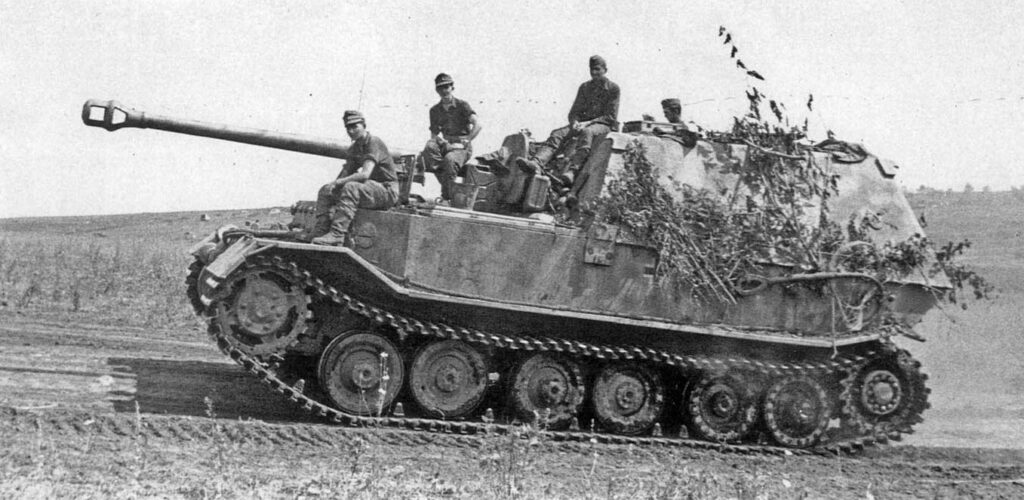
From Tiger (P) to Ferdinand
When Porsche lost the competition to produce the Tiger tank to Henschel in 1942, 90 of its already-assembled hulls were left without a role. Rather than scrap them, German engineers repurposed the chassis into a new heavy tank destroyer mounting the long-barreled 8.8 cm PaK 43/2 L/71 — an anti-tank gun with exceptional penetration and a proven record on the Eastern Front. These vehicles, dubbed Ferdinand after Ferdinand Porsche, were converted at the Nibelungenwerk factory in 1943 (Jentz, Panzer Tracts No. 9, 1997).
The rushed conversion, however, left little time for fine-tuning. Engineers focused on maximizing frontal armor and firepower, assuming the Ferdinand would fight from stand-off positions — far from infantry threats. The result was a tank destroyer that looked invincible on paper, but whose real-world performance would prove uneven.
Armor and Firepower Above All
With 200 mm of frontal armor — more than any Allied or Soviet gun could penetrate in 1943 — and a powerful 8.8 cm PaK 43/2 L/71, it was intended to destroy enemy armor from extreme range. This gun could knock out even a Soviet KV-1 or T-34 before they could get close.
However, the design had major flaws. It lacked a machine gun for defense against infantry. Crew visibility was poor, especially without a proper commander’s cupola. The drive system, inherited from the Tiger (P), was a complex hybrid of gasoline engines and electric motors, leading to frequent breakdowns. In muddy or rough terrain, its reliability dropped significantly (Anderson, Ferdinand and Elefant, 2015).
Kursk: Baptism by Fire
In July 1943, 89 Ferdinands were assigned to schwere Panzerjäger-Abteilungen 653 and 654 for Operation Citadel, the German offensive at Kursk. Their kill ratios in tank duels were high — the 8.8 cm gun performed exactly as expected. But the lack of infantry support, minefields, and technical problems caused catastrophic losses.
Soviet infantry, aware of the Ferdinand’s blind spots and lack of machine guns, closed in with Molotov cocktails and explosives. Several vehicles were immobilized not by combat, but by mechanical failure. Poor visibility meant crews often couldn’t spot threats until it was too late. Almost half the vehicles were lost — many abandoned and destroyed by their own crews to prevent capture (Jentz, 1997; Anderson, 2015).
A Beast Reborn
After the disaster at Kursk, surviving Ferdinands were recalled and rebuilt in early 1944. This was more than a repair — it was a redesign. The new vehicles received a hull-mounted MG 34 for close defense, a commander’s cupola for improved visibility, and Zimmerit paste to deter magnetic mines.
The refitted version was renamed Elefant to distinguish it from the original. These improved tank destroyers were returned to s.Pz.Jg.Abt. 653, where they saw combat in Italy (notably at Anzio and Nettuno), Poland, and in the defense of Berlin. Crews reported better survivability and situational awareness, but the underlying mobility issues remained (Anderson, 2015).
Rare Offshoots: Bergepanzer Ferdinand
Alongside the tank destroyers, at least three Tiger (P) chassis were converted into recovery vehicles, known as Bergepanzer Ferdinand. These support vehicles lacked the gun but retained a boxy superstructure for towing and repairs. Issued to s.Pz.Jg.Abt. 653, none are known to have survived the war (Anderson, 2015).
Legacy of the Elefant
The Ferdinand/Elefant was a paradox: nearly invincible from the front, but critically vulnerable up close. It was a machine designed for ideal battlefield conditions — long-range duels with no flank threat — that rarely existed in reality. While its firepower was unmatched, the design was over-engineered, under-defended, and too inflexible for the evolving nature of mechanized warfare.
Still, its influence is notable. It forced the Wehrmacht to confront the need for integrated infantry support and vehicle survivability — lessons applied in later designs like the Jagdpanther. Today, only two Elefants survive: one in Russia, and one in the U.S. at Fort Lee.
Technical Specifications
| Field | Ferdinand | Elefant |
|---|---|---|
| Years Active | 1943 | 1944–1945 |
| Total Produced | 90 | 48 (converted from Ferdinand) |
| Main Armament | 8.8 cm PaK 43/2 L/71 | 8.8 cm PaK 43/2 L/71 |
| Secondary Armament | None | 1 × MG 34 (hull) |
| Frontal Armor | 200 mm | 200 mm + Zimmerit |
| Crew | 6 | 6 |
| Weight | ~65 tons | Slightly heavier |
| Drive System | Tracked, electric/gas hybrid | Tracked, electric/gas hybrid |
| Manufacturer | Nibelungenwerk | Nibelungenwerk |
Photo Gallery
Above: An Elefant in Italy, 1944. Note the added MG 34 port and Zimmerit coating.
Below: Destroyed Ferdinand at Kursk, July 1943. The lack of a bow machine gun made it vulnerable to Soviet infantry.
Sources
Jentz, Thomas L., and Hilary Louis Doyle. Panzer Tracts No. 9: Jagdpanzer – Jagdpanzer 38 to Jagdtiger. Darlington, SC: Darlington Productions, 1997.
Anderson, Thomas. Ferdinand and Elefant Tank Destroyer. Oxford: Osprey Publishing, 2015.