The Nibelungenwerk, located in Sankt Valentin, Lower Austria, was Nazi Germany’s largest and most advanced tank production facility. Operated by Steyr-Daimler-Puch AG, it played a critical role in sustaining Panzer IV output from 1942 to 1945, and later assembled advanced vehicles like the Panzer IV/70(A) and the Jagdtiger.
Contents

Overview
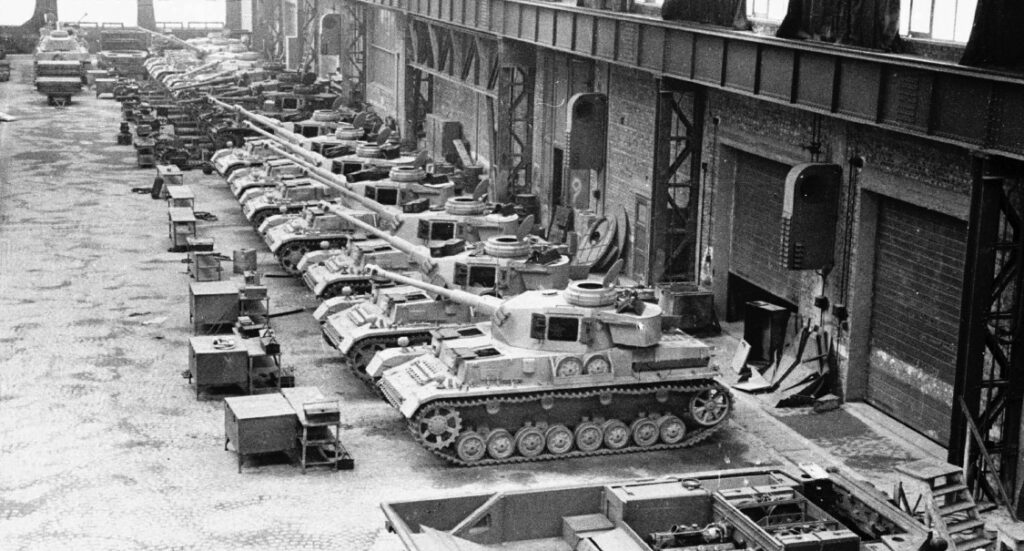
The Nibelungenwerk, located in Sankt Valentin, Lower Austria, was Nazi Germany’s largest and most advanced tank production facility during World War II. Operated by Steyr-Daimler-Puch AG, it played a critical role in sustaining Panzer IV output from 1942 to 1945 and later assembled advanced vehicles like the Panzer IV/70(A) and the Jagdtiger (Jentz and Doyle 2011, 23-50, 23-70).
Unlike other dispersed facilities, the Nibelungenwerk featured a modern, linear assembly process with industrial infrastructure designed to survive bombing raids. It produced a wide variety of armored vehicles and remained active into the final weeks of the war (Spielberger 1993, 40–68).
Location and Infrastructure
- Location: Sankt Valentin, Lower Austria
- Operator: Steyr-Daimler-Puch AG
- Start of Full-Scale Operations: 1942
- Main Products: Panzer IV (Ausf. F2 to J), Jagdpanzer IV, Panzer IV/70(A), Jagdtiger
- Workforce: Over 8,000 workers, including prisoners and forced labor
- Survival: One of the few German tank factories to remain largely intact after the war
Origins and Construction
Conceived in 1939 and championed by Reichswerke Hermann Göring AG, the Nibelungenwerk was located near a strategic rail hub and adjacent to Eisenwerke Oberdonau, a key steel supplier (Jentz and Doyle 2011, 23-4).
Construction occurred in four phases:
- Initial Steyr-based support workshops (1940)
- Wheel/tooling supply contracts (late 1940)
- Start of Panzer IV series production (1942)
- Full expansion with nine reinforced-concrete halls (1943)
All production halls were linked to dual rail lines and supported by a resilient underground utility network (Jentz and Doyle 2011, 23-4 to 23-6).
Workforce and Forced Labor
“Until 1942, sufficient volunteers could be found in allied and occupied territories to work in Germany. But as the war situation worsened, the Germans had to fall back on forceful measures. Using such means, by the end of 1944, the number of foreign civilian workers and prisoners of war increased to at least 8.2 million. In addition, there were about 700,000 concentration camp prisoners.”
Müller, Rolf-Dieter. Hitler’s Wehrmacht, 1935–1945. Translated by Janice W. Ancker. Lexington: University Press of Kentucky, 2016.
By late 1941, the plant employed around 4,800 Austrian and German workers. As the war progressed, German conscripts were replaced by foreign laborers and prisoners, including:
- French, Italian, Yugoslav, and Soviet POWs
- At least 600 Mauthausen-Gusen inmates
- Up to 1,500 forced laborers housed on-site
By the end of 1944, the workforce exceeded 8,500. A brothel was maintained in the camp for skilled workers, and many French laborers did not return from leave after the Normandy invasion (Jentz and Doyle 2011, 23-6).
Production Summary
The Nibelungenwerk’s primary output was the Panzerkampfwagen IV, especially variants Ausf. F through J.
These were assembled in collaboration with Krupp-Gruson and Vomag. Ni-Werk became the dominant builder of late-war models, particularly Ausf. J (Jentz and Doyle 2011, 23-50; Spielberger 1993, 40–68).
Vehicle Type: Panzerkampfwagen IV
Variants: Ausf. F–J
Quantity: ~4,800 produced
Notes: Largest single source (Jentz and Doyle 2011, 23–50; Spielberger 1993, 40–68)
Vehicle Type: Panzer IV/70(A)
Variants: L/70 on Panzer IV chassis
Quantity: 277
Notes: Aug 1944 – Mar 1945 (Jentz and Doyle 2011, 23–59)
Vehicle Type: Jagdtiger
Variants: Sd.Kfz. 186
Quantity: ~85
Notes: Final assembly at Ni-Werk (Jentz and Doyle 2011, 23–70)
Vehicle Type: Elefant conversions
Variants: From Tiger(P) chassis
Quantity: 90
Notes: May–July 1943 (Jentz and Doyle 2011, 23–56)
Vehicle Type: Repairs (late war)
Variants: Panthers & Tigers
Quantity: ~65 repaired
Notes: Spring 1945 (Jentz and Doyle 2011, 23–56)
The factory’s Waffenamt code was “hhv”, marked on chassis plates from 1941 onward (Jentz and Doyle 2011, 23-4).
Monthly Production Highlights
Panzer IV Ausf. H and J
- Output exceeded 300 tanks/month in the first half of 1944
- Decline followed by late 1944 due to logistical collapse and bombing
(Jentz and Doyle 2011, 23-51)
Panther Ausf. G
- Production continued through April 1945
- Last Nibelungenwerk-assembled Panther: Fgst.Nr. ~129104, accepted on 14 April 1945
(Jentz and Doyle 2011, 23-61 to 23-62)
October 1944 Bombing Raid
The intensified war situation forced Speer to shift the entire war economy into the service of armaments and to tap into the last reserves of the armaments themselves. […] Successful Allied attacks on the war economy’s key sites led to a race between repair and destruction, which overtaxed Speer’s powers. Production capacities were hampered, above all, by the scarcity of manpower. Now, even modern assembly-line production and the practice of multiple work shifts were limited to a few factories.
Müller, Rolf-Dieter. Hitler’s Wehrmacht, 1935–1945. Translated by Janice W. Ancker. Lexington: University Press of Kentucky, 2016.
An Allied air raid on 17 October 1944 damaged sections of the Nibelungenwerk in St. Valentin, temporarily disrupting production (Jentz and Doyle 2011, 23–51).
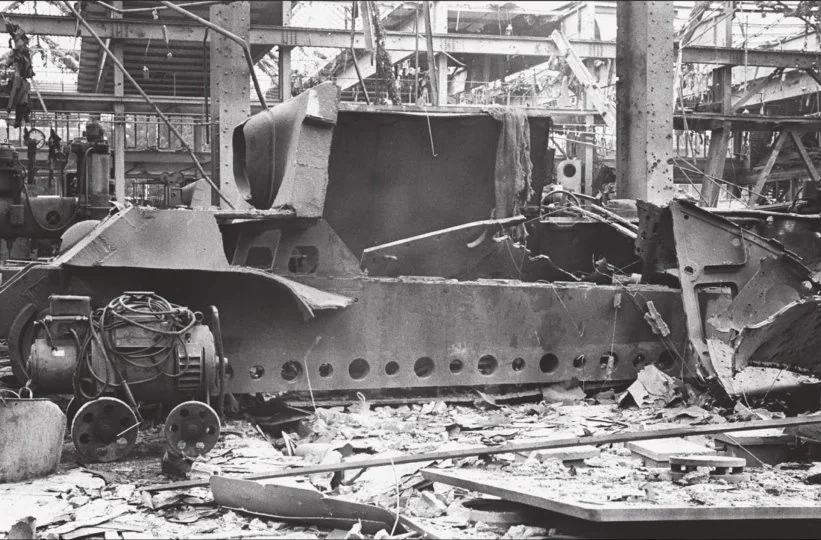
Nonetheless, Waffenamt production statistics indicate that 187 Panzerkampfwagen IV (Ausf. J) were completed in October 1944, underscoring the plant’s rapid recovery (Jentz and Doyle 2011, 23–51).
Across the 10. Serie/B.W. (Fgst.Nr. 86394–110272), approximately 3,160 Panzer IV Ausf. J were manufactured by Nibelungenwerk and Vomag between February 1944 and April 1945, confirming only a limited long-term impact from the bombing (Jentz and Doyle 2011, 23–56).
Final Days and Allied Capture
The plant remained active until the final weeks of the war. It was captured on 8 May 1945 by the 259th Infantry Regiment, 65th U.S. Infantry Division, which liberated the camp’s forced laborers (Jentz and Doyle 2011, 23-70).
The following day, Soviet forces took control. Some reports indicate a few Panzer IVs were completed or showcased in the Moscow Victory Parade (Jentz and Doyle 2011, 23-70).
Postwar Legacy
After 1945, the Werk St. Valentin was nationalized by the Austrian state and integrated into the postwar industrial structure (Ledwoch 1996, 58). In 1957, it was absorbed into Steyr-Daimler-Puch AG, becoming a core facility for agricultural machinery. By 1974, all tractor production of the Steyr Group was consolidated at the St. Valentin site, establishing it as the group’s primary center for agricultural vehicle development and manufacturing (Ledwoch 1996, 58).
Today, the former factory grounds are operated by Magna International and CNH Global. Several of the original production halls and testing areas remain in use for the manufacture of civilian vehicles and tractor cabins (CNH Industrial, Company History, accessed March 2025).
In 2021, an unexploded bomb from the Second World War was discovered on the premises, highlighting the site’s enduring link to its wartime role. from WWII was safely removed from the site — a lingering reminder of its wartime role.
Bibliography
- Jentz, Thomas L., and Hilary Louis Doyle. Panzer Tracts No. 23: Panzer Production from 1933 to 1945. Boyds, MD: Panzer Tracts, 2011.
- Müller, Rolf-Dieter. Hitler’s Wehrmacht, 1935–1945. Translated by Janice W. Ancker. Lexington: University Press of Kentucky, 2016.
- Spielberger, Walter J. Panzer IV and Its Variants. Translated by Edward Force. The Spielberger German Armor & Military Vehicles Series, Vol. IV. Atglen, PA: Schiffer Publishing Ltd., 1993.
This article is a synthesis of verified secondary sources and original factory production data. Its purpose is to clarify the strategic role of the Nibelungenwerk within the German war economy during the Second World War. All interpretations are grounded in published evidence; no claims are made beyond what the sources support.
Image Use Notice
The images included in this article are believed to be in the public domain; their precise provenance remains unclear. They are presented here strictly for educational and historical research purposes under fair use.