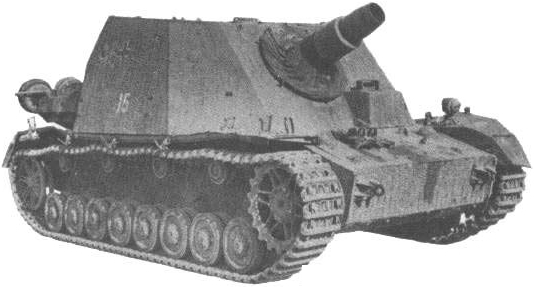
The Sturmpanzer IV, commonly known by the nickname Brummbär (“Grizzly Bear”) by Allied forces, was a German heavy assault gun developed during World War II to provide close support for infantry, particularly in urban or fortified environments. Mounted on the reliable Panzer IV chassis and armed with a formidable 15 cm gun, the vehicle played a specialized but crucial role on multiple fronts between 1943 and 1945.
Origins and Development
The concept for the Sturmpanzer IV emerged following lessons learned in Stalingrad and earlier Eastern Front operations, where German infantry units suffered high casualties while clearing urban strongpoints. The Wehrmacht needed a vehicle capable of demolishing bunkers, buildings, and fortified positions from short ranges.
To meet this requirement, a new vehicle was rapidly developed using the Panzerkampfwagen IV chassis, which was already in mass production and available in large numbers. The 15 cm Sturmhaubitze 43 (StuH 43) was selected as the main armament—a shortened and adapted version of the sFH 18 field howitzer—designed by Skoda specifically for armored use. Production began in early 1943, under the supervision of Alkett and Heereszeugamt Wien.
Design Features
The Sturmpanzer IV featured a fully enclosed casemate-style superstructure mounted on a Panzer IV chassis, heavily armored at the front with up to 100 mm of steel plate to protect against anti-tank weapons during direct assaults.
The key feature was the massive 15 cm StuH 43 L/12 howitzer, capable of firing HE shells weighing up to 38 kg, effective against fortifications and infantry concentrations. The gun was mounted in a limited traverse mount within the superstructure. Secondary armament was minimal or absent on early vehicles; later models received a roof-mounted MG 34 for close defense.
Despite its powerful armament, the vehicle suffered from its weight and limited mobility. The first 60 units were plagued by mechanical issues due to the overloaded chassis. A lighter version of the gun, the StuH 43/1, was introduced in later production to improve reliability.
Combat History
The Sturmpanzer IV saw its combat debut in the Battle of Kursk in July 1943, where it served in Sturmpanzer-Abteilung 216. Its effectiveness in reducing Soviet strongpoints justified continued production, despite the logistical burden.
Later, the vehicle was deployed in Italy, Normandy, and during the defense of Germany. Its most famous urban combat use occurred during the Warsaw Uprising in 1944, where its heavy gun was used against Polish resistance positions.
Although capable in its intended role, the Brummbär required close infantry coordination and suffered in mobile warfare. Vulnerabilities included its slow rate of fire, limited gun traverse, and lack of high-velocity AT capabilities.
Upgrades / Variants
The Sturmpanzer IV underwent four distinct production series:
- Initial Series (April–June 1943): 60 vehicles with early superstructure and full-weight StuH 43.
- 2nd Series (December 1943–March 1944): Incorporated lighter StuH 43/1 and minor changes.
- 3rd Series (Mid-1944): Introduction of a ball-mounted MG 34 in the superstructure front.
- 4th Series (1945): Based on the Panzer IV Ausf. J chassis, with simplified features for cost/time savings.
No formal variants existed beyond these series, though occasional field modifications included camouflage enhancements, Zimmerit coating, and crew stowage arrangements.
Performance Evaluation
The Brummbär fulfilled a niche tactical role with moderate success. Its destructive firepower made it effective in urban assaults and bunker-clearing, but it was not a tank destroyer and fared poorly in fluid battlefield conditions. The vehicle was underpowered and mechanically strained, a consequence of placing a heavy gun on a medium tank chassis. Crews often found it cramped and visibility limited.
Despite these drawbacks, its psychological and tactical impact during sieges and close-support operations was undeniable. Postwar assessments classify it as a special-purpose vehicle rather than a true multi-role armored platform.
Technical Specifications
| Variant | Chassis Base | Main Armament | Armor (Front) | Weight | Crew | Notes |
|---|---|---|---|---|---|---|
| Series 1 | Pz.Kpfw. IV Ausf. G | 15 cm StuH 43 L/12 | Up to 100 mm | ~28.2 tons | 5 | Initial production; heavy gun |
| Series 2–3 | Pz.Kpfw. IV Ausf. H | 15 cm StuH 43/1 | ~80 mm | ~27.5 tons | 5 | Improved gun, MG 34 added |
| Series 4 | Pz.Kpfw. IV Ausf. J | 15 cm StuH 43/1 | ~80 mm | ~27.5 tons | 5 | Simplified for late-war production |
Sources
Anderson, Thomas. Ferdinand and Elefant Tank Destroyer. Oxford: Osprey Publishing, 2015.
Further Reading / Related Links
- Panzer Tracts No. 8: Sturmgeschütze by Thomas L. Jentz
- Sturmpanzer: The Brummbär Assault Tank by Peter Chamberlain & Hilary Doyle (Osprey New Vanguard)
- Related vehicle profiles: [StuG III], [Panzer IV], [Jagdpanzer IV]